


15 May Plan a luxury Italian wedding in 2 months: expert guide
Two months. That is all the time you have, and your vision involves lake-draped villas, Michelin-starred menus, and a guest list that expects nothing less than extraordinary. The pressure is real, but so is the possibility. Couples who approach a fast-track luxury wedding in Italy with disciplined strategy, bold decision-making, and the right expert team consistently produce celebrations that rival events planned over twelve months. This guide walks you through every step, every week, and every critical decision you need to make right now to turn that breathtaking Italian dream into a flawless, unforgettable reality.
Table of Contents
- Setting the scene: Essential requirements for a fast-track wedding
- The two-month master timeline: Step-by-week breakdown
- Securing core vendors, venues, and luxury touches
- Design, logistics, and day-of execution: Ensuring a seamless celebration
- Our take: Why fast-track luxury weddings in Italy require bold decision-making
- Connect with Italy’s luxury wedding experts for seamless planning
- Frequently asked questions
Key Takeaways
| Point | Details |
|---|---|
| Rapid decisions are vital | Swift, confident choices from the start enable luxury weddings to come together within two months. |
| Planner networks save time | Leverage experienced planners’ vendor relationships and expertise to secure resources quickly for upscale celebrations. |
| Digital tools accelerate planning | Use digital invitations, RSVPs, and virtual tastings for seamless communication and speed. |
| Prioritize key vendors | Focus on booking your photographer, venue, caterer, and florist early to secure luxury options. |
| Delegate and double-check logistics | Delegating tasks to professionals and conducting thorough checks prevents costly errors under a tight timeline. |
Setting the scene: Essential requirements for a fast-track wedding
Before you draft a single email to a florist or browse venue photos, you need to understand what a two-month Italian luxury wedding actually demands as prerequisites. This is not the moment for leisurely browsing. It is the moment for sharp clarity on what must be secured before week one even begins.
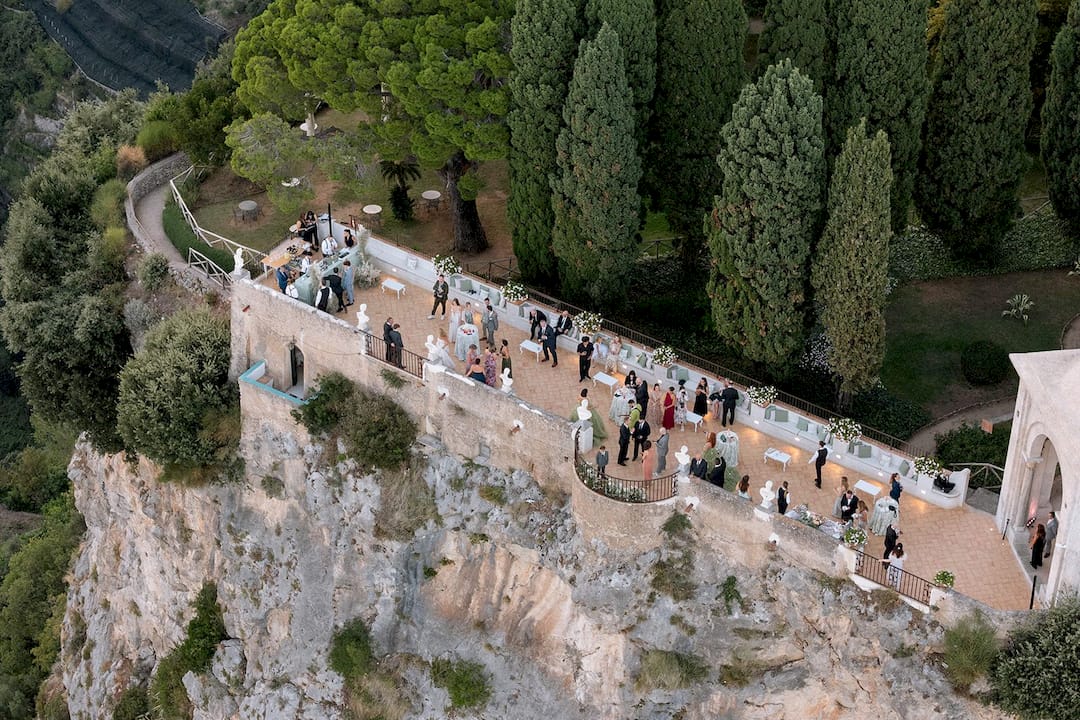
The first non-negotiable is a venue. Italian luxury venues, whether a Tuscan hillside estate, a cliffside property on the Amalfi Coast, or a grand palazzo on Lake Como, book fast. A last-minute inquiry is not a weakness; it is a signal that you need a planner with existing relationships who can unlock availability that never appears on public calendars. A classic Catholic wedding at Villa Cora in Tuscany or an intimate celebration at Villa Pizzo on Lake Como are examples of venues that regularly open unexpected slots to trusted planners. That relationship is your most valuable asset at this stage.
The second prerequisite is a luxury wedding planner, ideally retained within the first 72 hours of your decision to move forward. Your planner is your operational partner. They manage vendor networks, handle Italian bureaucratic requirements, and provide access to venues and suppliers that are otherwise inaccessible on short notice.
Here is a quick-reference checklist of what must be in place before week one officially begins:
- Venue shortlist confirmed (minimum two options with availability checks)
- Luxury wedding planner retained with a signed contract
- Budget ceiling established and communicated clearly
- Ceremony type decided (symbolic or legally binding, as this affects documentation timelines significantly)
- Approximate guest count confirmed (within ten people is sufficient at this stage)
- Core travel logistics outlined for the couple and key family members
- Passport and identification documents verified for validity
The table below gives you a clear picture of the key planning categories and what needs to happen before formal planning begins versus what can follow in the first weeks.
| Category | Must secure before week one | Can be addressed in weeks one to two |
|---|---|---|
| Venue | Shortlist and availability confirmed | Final contract signed |
| Planner | Retained and briefed | Full brief document delivered |
| Ceremony type | Decided (symbolic vs. legal) | Documentation process started |
| Guest count | Approximate figure agreed | Final RSVP list compiled |
| Accommodation | Research started | Luxury hotel block reserved |
| Attire | Style direction decided | Off-rack or designer selection made |
| Budget | Hard ceiling set | Category allocations confirmed |
Strategic destination venue planning principles apply regardless of geography. Securing availability confirmation quickly and moving decisively to deposit stages is what separates couples who succeed on tight timelines from those who find themselves scrambling. Properties like the Grand Hotel des Iles Borromées on Lake Maggiore, for example, often have partial availability windows that a skilled planner can convert into a full buyout or dedicated event space arrangement.
Regarding legal requirements: Italy requires specific civil documentation for legally recognized marriages, including certified copies of birth certificates, apostille stamps, and official translations. This process takes time. If your two-month window makes the legal route difficult, a symbolic ceremony is a legitimate, beautiful alternative and allows far greater creative flexibility in venue and structure. Discuss this decision with your planner in the first consultation.
The two-month master timeline: Step-by-week breakdown
Armed with a checklist of requirements, here is how to execute each week for maximum progress and minimum stress. The key principle is parallel action. You cannot afford sequential planning. Every major category must move forward simultaneously.
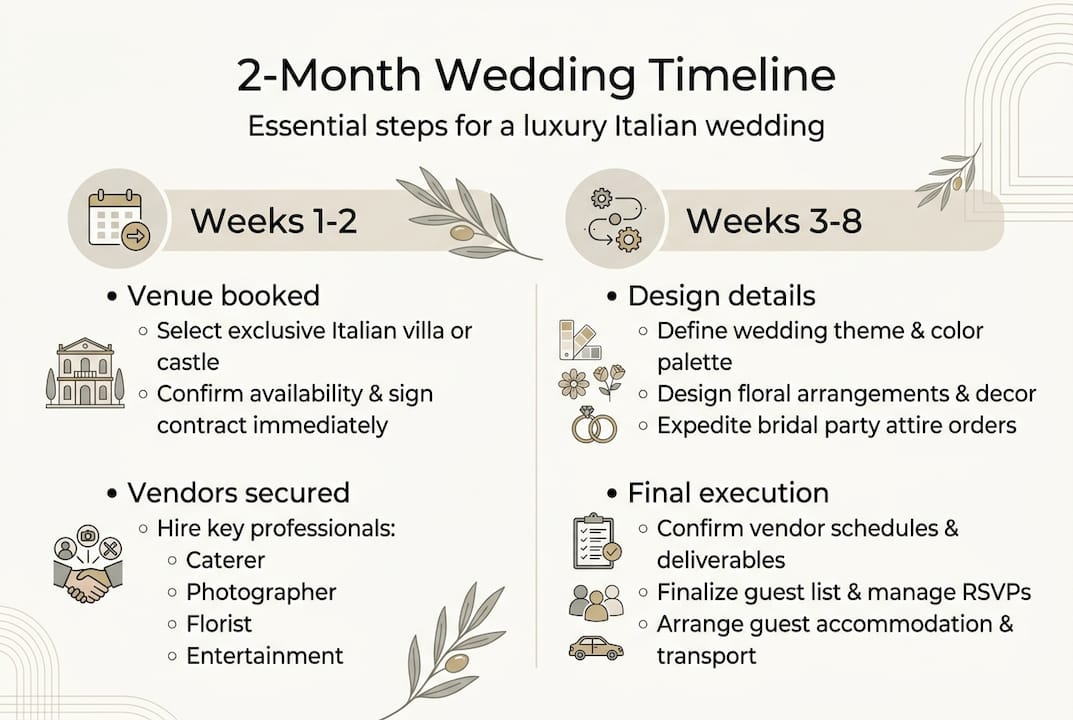
Weeks one and two: Foundations
- Retain your luxury wedding planner and schedule a full briefing call within 48 hours
- Confirm venue availability and send the deposit for your first-choice property
- Communicate ceremony type to your planner to begin the legal or symbolic pathway
- Reserve a block of rooms at a nearby luxury hotel for guests (confirm hold with a small deposit)
- Send digital save-the-dates to your guest list immediately, include a hotel block link
- Begin researching and shortlisting photographers and videographers
Weeks three and four: Core vendor booking
Following expert booking guidance, this is the critical window to book all core vendors in parallel. Do not finish booking one vendor before starting conversations with the next. Your planner’s network makes this possible at the luxury level.
- Book your photographer and videographer first (they are the scarcest luxury suppliers)
- Lock in your caterer (or confirm catering arrangements with the venue if it is an exclusive-use property)
- Book your florist and design team
- Confirm your music entertainment (live orchestra, jazz quartet, or DJ depending on your vision)
- Arrange guest transport, including arrivals from airports and ceremony-to-reception transfers
- Select your attire from off-rack designer collections or ready-to-wear couture; avoid custom orders that require fittings over months
- Launch digital invitations with RSVP functionality to track responses in real time
Weeks five and six: Design and logistics
According to a structured wedding planning countdown, weeks five and six are the window for finalizing all aesthetic and logistical details.
- Conduct virtual tastings for catering and cake selection
- Approve floral and décor design concepts with your florist
- Confirm all transport logistics and create a detailed guest journey itinerary
- Finalize welcome bag contents and arrange assembly and delivery to the hotel
- Complete day-of timeline with your planner (ceremony timing, cocktail hour flow, reception schedule)
- Confirm all contracts are signed and payment schedules are current
Weeks seven and eight: Final execution
- Confirm all vendors one week before the wedding with a detailed briefing document
- Conduct a venue walkthrough with your planner and key vendors
- Distribute day-of timeline to all vendors, venue staff, and family members in key roles
- Confirm final guest count with caterer
- Enjoy your wedding
The table below compares a standard planning timeline with the fast-track approach, so you can see exactly where the compression happens.
| Planning phase | Standard timeline | Fast-track (two months) |
|---|---|---|
| Venue search and booking | Months one to three | Days one to seven |
| Vendor booking | Months two to six | Weeks two to four (parallel) |
| Design approvals | Months four to six | Weeks five to six (virtual) |
| Invitations sent | Four to six months out | Week two (digital) |
| Attire ordered | Six to twelve months out | Week three (off-rack/ready-to-wear) |
| Final confirmations | One month out | Week seven |
Pro Tip: Ask your planner to hold vendor introductory calls on back-to-back days during week two. Grouping these conversations tightly means decisions happen in days rather than spread across weeks, which is what makes or breaks the two-month timeline.
The contemporary drama of a Belmond Hotel Cipriani wedding in Venice or the intimate editorial atmosphere of a celebration at Gucci Osteria in Florence are examples of weddings that came together through this kind of focused, parallel execution. The common thread in both was a planner who treated vendor booking not as a sequence but as a simultaneous sprint.
Securing core vendors, venues, and luxury touches
Once your timeline is mapped, the real challenge is sourcing and locking in the vendors who create the Italian luxury experience. This is where many couples underestimate the complexity. Italy’s top-tier wedding suppliers are in demand year-round, and last-minute availability at the luxury level often depends entirely on planner relationships.
The booking order matters. Experienced planners prioritize photographers and videographers first, followed by caterers, florists, music, and transport. The reason is simple: skilled luxury photographers with strong portfolios and a track record at Italian venues are the fastest to disappear from availability calendars. A spectacular venue photographed poorly is a missed opportunity. A modest venue photographed by a master storyteller becomes timeless.
Here is the full vendor booking priority list for a fast-track luxury Italian wedding:
- Priority one: Photographer and videographer (book within the first ten days)
- Priority two: Caterer (or confirm venue’s exclusive catering arrangement)
- Priority three: Florist and décor designer
- Priority four: Live entertainment (orchestra, band, or DJ at the appropriate luxury tier)
- Priority five: Guest transport (private cars, water taxis on lake venues, or coach services)
- Priority six: Hair and makeup artists (for the couple and potentially bridal party)
- Priority seven: Wedding cake designer or specialty dessert supplier
- Priority eight: Lighting and AV specialists if not included with the venue
The luxury touches that distinguish a world-class Italian wedding from a beautiful but standard event often come from the details. Custom welcome bags assembled for guests at their hotel might include locally sourced limoncello, artisanal Sicilian almonds, hand-printed maps of the region, and monogrammed accessories. These details communicate generosity and thoughtfulness, and they are achievable within a two-month window if you brief your planner clearly during week one.
Consider the cinematic luxury of a Villa Cimbrone wedding in Ravello, where ceremonies perched above the Tyrrhenian Sea create a setting so dramatic that every design element is elevated simply by its surroundings. Or the sleek, contemporary atmosphere of a modern celebration at Villa Erba on Lake Como, where the architecture itself becomes part of the design language. In both cases, the planner’s vendor network was the mechanism that made each component come together precisely.
Pro Tip: When negotiating with vendors under time pressure, be upfront about your timeline. Experienced luxury vendors respond well to transparency and a clear brief. Offering a prompt deposit (within 24 to 48 hours of agreement) is often more persuasive than any price negotiation and signals that you are a serious, reliable client.
Couples are sometimes surprised to learn that many premium vendors actually prefer working with focused, decisive clients on shorter timelines. The reason is that compressed planning cycles reduce the number of revision rounds and back-and-forth communications that can stretch across months in longer engagements. When you know what you want and commit quickly, you become a vendor’s ideal client.
Design, logistics, and day-of execution: Ensuring a seamless celebration
With your vendor lineup secured, it is time to polish the event’s design, logistical harmony, and execute a flawless day. This phase, typically weeks five through eight, is where vision becomes reality and where the difference between a good wedding and a transcendent one is decided.
Virtual tastings have become an invaluable tool for couples planning destination weddings on tight schedules. Your caterer can prepare a curated selection of menu items and present them via video call, walking you through flavor profiles, presentation, and pairing suggestions. This approach saves time without sacrificing the sensory pleasure of menu selection. The same principle applies to floral consultations, where a skilled florist can present three-dimensional mood boards, scaled mock-ups, and material samples via high-resolution digital presentations. These tools mean you do not need to be physically present in Italy during the design finalization phase.
Precise day-of logistics are what separate a seamlessly flowing celebration from one that feels fragmented. A detailed timeline should account for every movement: when the first guests arrive at the hotel, when transport departs for the ceremony, how long the cocktail hour runs before the reception room opens, when speeches are scheduled, and at what point the evening transitions from dinner to dancing. Every vendor receives a copy of this document. Every key family member has a simplified version.
Key logistics elements to finalize in weeks five and six:
- Guest transport schedule: Confirm pickup times, vehicle types, and driver contacts for all transfers
- Ceremony timing: Coordinate with officiant, musicians, and venue staff on exact sequence
- Cocktail hour flow: Brief waitstaff and bar team on service style and timing
- Reception timeline: Dinner service, speeches, cake cutting, and first dance sequence confirmed
- Day-after breakfast or brunch: If included, coordinate with hotel for group reservation
- Emergency contacts list: Distribute to your planner, venue coordinator, and a trusted family member
For legal weddings, Italian civil ceremonies require specific documents including a Nulla Osta (a certificate of no impediment issued by your home country), which must be obtained and translated before the ceremony. Your planner will guide you through this process. For symbolic ceremonies, the paperwork burden is significantly lighter, which is one reason many international couples opt for this format and handle their legal registration at home before or after the Italian celebration.
Before signing any vendor contract, review payment schedules carefully and confirm that all key deliverables are specified in writing. This protects both parties and ensures that every luxury detail you have discussed verbally is documented and enforceable.
The cinematic wedding at Belmond Hotel Caruso in Ravello is a compelling example of meticulous day-of execution. The venue’s position above the Amalfi Coast creates natural drama, but what made that event seamless was a day-of timeline so detailed it accounted for golden-hour portrait timing between the ceremony and reception. That level of precision is entirely achievable in two months when the planning process is structured correctly from the start.
Our take: Why fast-track luxury weddings in Italy require bold decision-making
Now, let us get real about the mindset needed for a successful fast-track luxury celebration.
The single biggest obstacle we observe in accelerated wedding planning is not a shortage of available venues or unwilling vendors. It is indecision dressed up as perfectionism. Couples who spend two weeks choosing between three nearly identical floral centerpiece options while their window to confirm the caterer closes are not protecting quality. They are eroding it.
Here is the uncomfortable truth: a two-month luxury wedding will not look exactly like the meticulously customized, twelve-month production you might have imagined. It will look different. In many cases, it will look better, because the constraints force clarity. When you cannot agonize over forty invitation designs, you choose decisively and the choice is usually excellent. When you cannot commission a fully bespoke gown, you select a ready-to-wear piece from a great designer, and the fit is often more flattering than something constructed without adequate time for proper fittings.
Bold decisions create memorable results. The romantic Jewish wedding at Villa Erba on Lake Como is a clear illustration: the couple committed quickly to a venue with a strong existing aesthetic, trusted their planner’s florist recommendation without extensive comparison shopping, and the result was a celebration that felt entirely personal and visually cohesive. The boldness of those quick decisions did not compromise the luxury. It concentrated it.
What two months can deliver: a breathtaking venue, a world-class photography team, exceptional food and wine, elegant floral design, seamless guest logistics, and an atmosphere of genuine Italian romance. What it cannot deliver: endless customization rounds, bespoke items requiring months of artisan production, or deeply personal stationery suites with hand calligraphy ordered in small batches. The trade-off is real, and accepting it is the first act of bold decision-making required.
Our view is that the couples who succeed with fast-track luxury weddings are those who treat their planner as a true partner rather than a service provider. That means trusting recommendations, moving on decisions within 24 hours, and resisting the urge to introduce new variables late in the process. A planner who knows Italy’s luxury wedding ecosystem can navigate a two-month timeline with extraordinary results. Your job is to stay decisive and let them do exactly that.
Connect with Italy’s luxury wedding experts for seamless planning
Ready to shortcut the stress and make your luxury Italian wedding dreams reality? At SposiamoVi, we specialize in exactly this kind of curated, high-precision planning for international couples who want Italy’s finest venues, vendors, and experiences delivered within a tight timeline. Our planners have deep, trusted relationships with Italy’s most exclusive properties and suppliers, which means we can unlock availability and secure commitments that simply are not accessible through general inquiries.
Whether you are drawn to the idea of a bespoke luxury destination wedding in Italy with every element tailored to your vision, curious about the 10 features that define an authentic Italian wedding, or looking for inspiration on gourmet serving ideas for a stylish Italian reception, our resources and team are here to guide you. Contact us today to schedule your first consultation and take the first decisive step toward your extraordinary Italian celebration.
Frequently asked questions
Is it possible to plan a luxury wedding in Italy in just two months?
Yes, with decisive action and expert guidance, you can organize a luxury Italian wedding within a two-month timeframe by focusing on essential vendors first and leveraging planner networks for rush availability. The key is parallel booking and bold, prompt decision-making from day one.
What is the fastest way to secure luxury guest accommodations for a wedding in Italy?
Block nearby luxury hotels for guests as early as possible in week one and rely on your planner’s existing hotel relationships to secure premium rooms that may not be publicly available. A small holding deposit typically confirms a room block quickly.
How can symbolic and legal ceremonies be managed quickly?
Symbolic ceremonies involve minimal paperwork and are ideal for couples on tight timelines, while legal weddings require early documentation steps including apostilles and official translations. For symbolic-only ceremonies, your planner can complete arrangements in weeks rather than months.
Can digital invitations and RSVPs accelerate wedding planning?
Digital invites and RSVP tools are strongly recommended for fast-track weddings because they eliminate print production timelines and allow real-time tracking of guest responses. They are widely accepted at the luxury level and can be designed to feel as refined as printed stationery.