


20 May What full-service wedding planning includes for Italy
Hiring a wedding planner sounds simple until you realize that planning a luxury destination wedding in Italy is less like booking a hotel and more like producing a world-class event in a foreign country where the language, legal system, and vendor culture operate entirely on their own terms. Many couples arrive at the process imagining they need someone to “handle the details,” only to discover that a truly full-service planner is the architect, the translator, the negotiator, and the creative director of the most significant celebration of their lives. This guide explains exactly what full-service planning entails, how it differs from partial coordination, and why it is the only approach that consistently delivers the seamless, bespoke Italian celebration you have envisioned.
Table of Contents
- Defining full-service wedding planning in Italy
- Key services included in full-service wedding planning
- How full-service planning ensures a seamless and personalized experience
- Selecting the right full-service planner for your Italian wedding
- Common misconceptions about full-service wedding planning
- What most guides miss about full-service wedding planning in Italy
- Experience bespoke full-service wedding planning in Italy
- Frequently asked questions
Key Takeaways
| Point | Details |
|---|---|
| Comprehensive event management | Full-service planning covers every detail, from vision to execution, ensuring nothing is overlooked. |
| Personalized luxury experiences | Planners deliver bespoke and culturally meaningful events, finely tuned to your wishes. |
| Peace of mind for international couples | Expert planners handle legal, logistical, and guest travel complexities, reducing stress for couples abroad. |
| Thorough planner selection matters | Choosing an experienced, creative, and communicative planner is key to a fulfilling destination wedding. |
| Myth-busting | Beware of common misconceptions; full-service planning is about collaboration, not loss of control. |
Defining full-service wedding planning in Italy
With the scope of Italian destination weddings established, it is essential to define exactly what full-service planning means and how it sets the foundation for a personalized celebration.
Full-service wedding planning is not simply a longer checklist. It is a complete, end-to-end relationship that begins the moment you decide on Italy and continues well past the last guest’s departure transfer. In practical terms, it covers every touchpoint of your wedding experience: initial concept development, venue scouting and selection, vendor contracting, legal documentation, guest communications, travel logistics, event production, and post-wedding aftercare. Nothing falls outside the planner’s scope because nothing is insignificant when the stakes are this high.
The distinction between a full-service provider and a partial or “month-of” coordinator is significant. Partial planners step in at a designated stage, often assuming that earlier decisions were made correctly. Day-of coordinators, perhaps the most misunderstood category, are present only during the event itself and have no influence over the months of preparation that determine whether the day actually flows. In Italy specifically, where venues require early exclusivity contracts and civil ceremony paperwork must be submitted to the local municipality (Comune) weeks in advance, entering the process late is a costly mistake.
What truly separates a luxury full-service provider is local knowledge and established supplier relationships. Italy’s finest venues, such as a storied Lake Como villa wedding setting at dawn, are rarely available through generic booking platforms. They are accessed through years of cultivated relationships between planners and estate managers, catering directors, and local artisans. Those relationships translate directly into preferred access, better pricing leverage, and higher quality of service for your event.
“A full-service planner is not a middleman. They are your creative partner, your local advocate, and your single point of accountability for every decision made on your behalf in Italy.”
Key characteristics that define genuine full-service planning include:
- Concept to completion ownership: The planner is responsible from vision to execution with no handoffs.
- Dedicated point of contact: One senior planner manages your file, not a rotating team of assistants.
- Proactive problem solving: Issues are resolved before you know they exist, not escalated to you for decisions.
- Legal and administrative fluency: The planner navigates Italian civil, religious, and symbolic ceremony requirements without relying on you to interpret documents.
- Vendor ecosystem: Access to a curated network of photographers, florists, caterers, musicians, and artisans who perform at the standard your celebration demands.
Key services included in full-service wedding planning
Now that we have defined full-service planning, let us break down the specific offerings that set these luxury experiences apart.
A genuinely full-service package for an Italian destination wedding spans several interconnected service categories. Each one requires expertise, and collectively they form the framework that transforms your vision into a living, breathing celebration.
| Service category | What it includes |
|---|---|
| Concept and design | Mood boards, color palettes, floral direction, lighting concepts, styling |
| Venue selection | Research, site visits, contract review, and exclusivity negotiation |
| Vendor management | Sourcing, vetting, contracting, and coordinating all suppliers |
| Legal and administrative | Civil, religious, or symbolic ceremony paperwork and municipal filings |
| Guest logistics | Accommodation blocks, transport scheduling, and welcome communications |
| Event production | Timeline creation, rehearsal direction, and day-of execution |
| Travel coordination | Arrivals, departures, private transfers, and itinerary building |
| Aftercare | Vendor payments, gift collection, and post-event wrap-up |
For a romantic Indian destination wedding held at Lake Como, this level of service might mean coordinating a three-day event that includes a Mehndi ceremony, a traditional Indian ceremony, and a Western-style reception, all staged across multiple venues with separate vendor teams, cultural requirements, and dietary considerations for 150 international guests. That is not a checklist. It is a production.

Similarly, a classic Tuscany wedding involving a Catholic ceremony at a historic villa requires coordination between the diocese, the estate, an international florist, a locally sourced string quartet, and a reception caterer who can produce a six-course tasting menu paired with regional wines. Each layer of that event is managed, cross-referenced, and protected by your full-service planner.
Pro Tip: When interviewing planners, ask specifically what locally unique experiences they can arrange beyond the ceremony and reception. A great planner will suggest private vineyard dinners, exclusive olive oil tastings, sunrise boat rides on the lake, or access to closed museum spaces for intimate cocktail hours. These moments are what elevate a beautiful wedding into a genuinely unforgettable experience.
Additional specialty services that distinguish luxury full-service providers include:
- Multilingual support: Communication in English, Italian, and often additional languages for multinational guest lists.
- Cultural and religious accommodation: Managing requirements for Hindu, Jewish, Muslim, Catholic, or interfaith ceremonies with equal fluency.
- Multi-event programming: Designing and producing welcome dinners, day-after brunches, and pre-wedding excursions as a cohesive series rather than disconnected events.
- Bespoke stationery and gifting: Coordinating custom save-the-dates, menus, place cards, and curated welcome boxes for guests.
- On-site troubleshooting: Dedicated team presence throughout the event to manage timing, weather contingencies, and supplier issues in real time.
How full-service planning ensures a seamless and personalized experience
Understanding the extent of services offered, it is equally vital to see how a full-service approach impacts your and your guests’ experience from the very start.
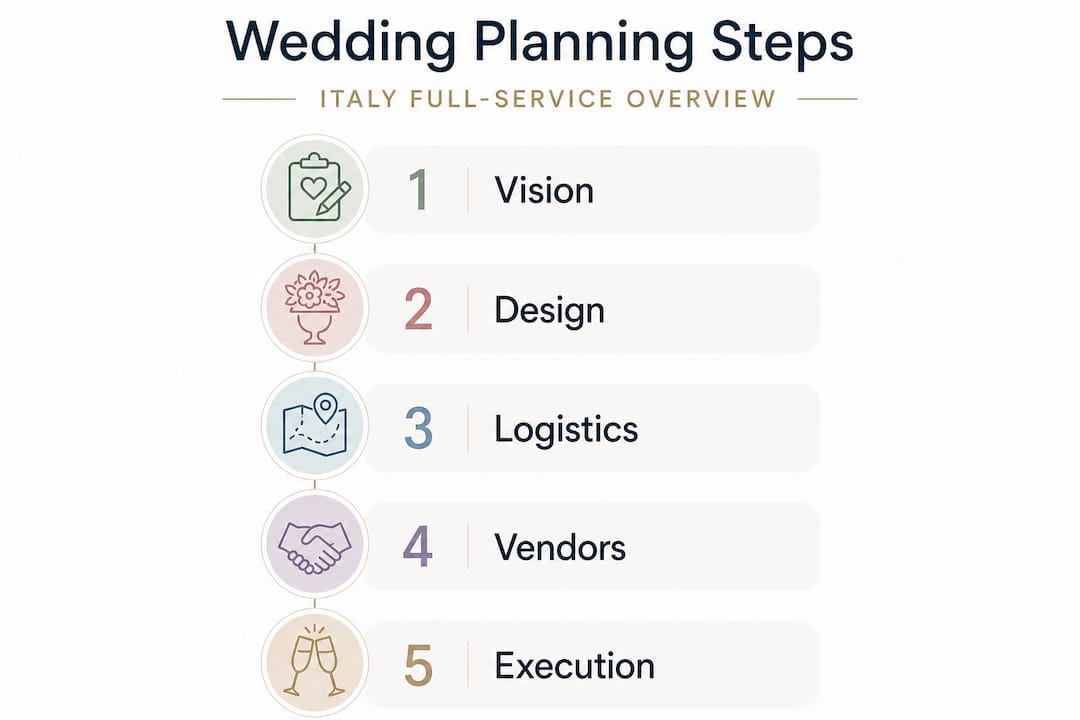
International couples face a unique set of challenges when planning an Italian destination wedding. Language barriers, time zone differences, unfamiliar legal frameworks, and the sheer distance from your vendors can make even simple decisions feel overwhelming. Full-service planning is specifically designed to absorb those friction points so that your experience remains inspired and enjoyable rather than stressful.
| Planning approach | What is covered | Best suited for |
|---|---|---|
| Full-service planning | Everything, from concept through execution and aftercare | International couples, luxury celebrations, multi-event weekends |
| Partial planning | Specific stages, such as vendor selection or design only | Couples with time to manage logistics personally |
| Day-of coordination | Event-day timeline management only | Local weddings where all planning is already complete |
The difference is not just convenience. For an intimate Florence wedding, every detail from the table arrangement to the ambient lighting requires pre-event conversations with the venue, approvals from management, and a precise setup schedule. A day-of coordinator arrives to find those arrangements either done or not. A full-service planner ensured they were done correctly months earlier.
Here is how a full-service planner personalizes the journey, step by step:
- Discovery consultation: Your planner conducts an in-depth interview to understand your style, cultural background, guest dynamics, and priorities before any venue is suggested.
- Vision document creation: A tailored brief is prepared that captures your aesthetic, tone, and non-negotiables. This becomes the reference point for every vendor and venue discussion.
- Venue curation: Based on your vision, two to four venues are presented with personalized context, not a generic list.
- Vendor selection aligned to your vision: Each vendor is chosen to match your brief, not simply because they are available or affordable.
- Guest journey mapping: Every touchpoint your guests will experience, from the welcome transfer to the farewell brunch, is designed as part of a cohesive narrative.
- Ongoing communication protocol: Weekly or biweekly updates, shared planning platforms, and regular video calls keep you informed and in control without overwhelming you.
- Pre-wedding preview visit: A site visit with your planner lets you walk the ceremony space, review the setup plan, and make final adjustments before your guests arrive.
Pro Tip: Before signing with any planner, ask specifically how they manage communication for international clients across different time zones. Request their standard update schedule and ask whether you will have access to a shared project management system. Planners who can answer this confidently have built their process with global clients in mind. Also, if you are considering adding pre-wedding parties to your Italy itinerary, a full-service planner can integrate those seamlessly into your overall program.
Selecting the right full-service planner for your Italian wedding
Even with a clear understanding of full-service planning, choosing the right collaborator is crucial to translating your vision into reality.
The luxury Italian wedding market has grown substantially, and not every planner who uses the word “bespoke” in their marketing is offering a genuinely personalized service. Selecting the right partner requires deliberate evaluation across several dimensions, and it is worth taking the time to assess thoroughly before committing.
Criteria to evaluate when choosing your full-service Italian wedding planner:
- Portfolio diversity: Does their work reflect a range of styles, cultures, and venues, or does every wedding look nearly identical? A strong portfolio, including a luxury Ravello celebration or an intimate countryside gathering, demonstrates genuine creative range.
- Experience with international clients: Ask how many overseas couples they have served in the past three years and whether they have worked with couples from your home country or culture.
- In-house versus outsourced services: Understand which services are handled by the planner’s own team and which are subcontracted. In-house teams offer greater accountability and consistency.
- Client references: Request two or three references from previous international clients and ask specifically about communication quality, crisis management, and whether the final event matched the original vision.
- Transparency in pricing: Luxury planning fees vary widely. A reputable planner presents fees clearly and explains exactly what each cost covers, with no hidden charges emerging after contract signing.
- Legal and administrative fluency: Ask directly whether they manage all Italian paperwork in-house or whether they refer you to a separate legal advisor. The best planners handle both.
- Creative vision alignment: Review their concept proposals. Do they feel genuinely inspired by your brief, or do they offer a templated presentation they use for every couple?
Pro Tip: Ask to see three to five real wedding portfolios before your first formal consultation. Pay attention to the details in each wedding: florals, table design, lighting, and guest experience elements. This tells you far more about a planner’s taste, creativity, and execution standard than any marketing copy can.
Common misconceptions about full-service wedding planning
As you refine your expectations, it is important to separate myth from reality when evaluating what full-service planning truly offers.
Misconceptions about full-service wedding planning are surprisingly common, even among well-traveled, experienced couples. They often lead people to undervalue the service, resist committing to it fully, or choose a less capable provider based on faulty assumptions.
Common myths worth addressing directly:
- “Full-service planners take over and remove my choices.” In reality, full-service planning is designed to give you more meaningful choices by eliminating the noise. Your planner does not dictate. They present curated options based on your established vision and support your decisions with expertise.
- “It is just about convenience, not personalization.” Convenience is a byproduct. The actual goal is a celebration that reflects who you are as a couple, your shared history, your aesthetic, and your guests’ experience. Personalization is the entire point.
- “Local Italian planners cannot understand international client expectations.” The finest Italian wedding planners have spent years cultivating a deep understanding of global client cultures, from British restraint to American warmth to South Asian ceremonial traditions. Cultural fluency is a core competency for any planner who serves an international market.
- “I can manage most of this myself and just hire someone for the day.” For a domestic wedding with familiar vendors and local logistics, this approach might work. For a luxury Italian destination wedding with legal requirements, language barriers, cross-border payments, and international guest logistics, it almost always results in preventable stress and avoidable mistakes.
- “Full-service planning is only worth it for very large weddings.” An intimate gathering of thirty guests in Tuscany requires just as much legal coordination, venue management, and vendor oversight as a reception of two hundred. The service is scaled to your event, but the complexity of operating in Italy applies regardless of guest count.
“The best full-service planners do not simply execute a plan. They build a relationship with each couple that allows them to anticipate needs, navigate change, and protect the couple’s vision at every turn.”
What most guides miss about full-service wedding planning in Italy
Most articles about Italian wedding planning treat full-service coordination as a premium add-on, something you upgrade to when your budget allows. That framing misses the point entirely.
In our experience working with international couples across Italy’s most coveted locations, the couples who struggle most are not those with the smallest budgets. They are the ones who underestimated how much cultural, legal, and logistical expertise is required to realize a genuinely bespoke celebration in Italy. They hired coordinators rather than planners, or they split the responsibilities among multiple vendors without a single point of creative and logistical authority. The result is a wedding that looks beautiful in photographs but felt fragmented on the day.
The second thing most guides miss is the role of personal connection. Full-service planning is not a transactional service. The best outcomes happen when a couple and their planner develop a genuine creative relationship over months of collaboration. That relationship is what allows a planner to say, “I know you said you wanted a traditional ceremony, but based on everything we have discussed, I think you would love this alternative arrangement,” and be right.
There is also a persistent myth that sophistication and personalization are in conflict with efficiency. Experienced luxury planners know this is false. A modern Lake Como celebration can be meticulously produced, down to the last candle placement and transport schedule, and still feel entirely organic to the couple and their guests. That is the art of great planning. Precision in the background creates freedom in the foreground.
Finally, the right planner does not just match your brief. They grow with it. Over the course of planning, your vision will evolve. New ideas will emerge. Circumstances will change. A full-service planner who is rigidly executing a script will fail to adapt. One who has built a genuine collaborative relationship with you will evolve the plan alongside you, protecting the integrity of the original vision while accommodating the natural refinements that happen over twelve to eighteen months of preparation.
Experience bespoke full-service wedding planning in Italy
SposiamoVi specializes in comprehensive Italian wedding planning for international couples who want a seamless, deeply personalized celebration across Italy’s most iconic locations. From Lake Como to the Amalfi Coast, Tuscany to Puglia, the team brings local expertise, established vendor relationships, and a genuine commitment to realizing your vision rather than a template. Whether you are envisioning an intimate civil ceremony in a private villa or a multi-day cultural celebration with hundreds of guests, the portfolio of luxury destination weddings in Italy reflects a consistent standard of elegance and personalization. Reach out to begin a conversation about your Italian wedding and discover what truly full-service planning feels like from the first call.
Frequently asked questions
How does full-service wedding planning differ from day-of coordination?
Full-service planning covers every aspect from initial concept and legal paperwork through to vendor management and post-event wrap-up, while day-of coordination only manages execution during the event itself, assuming all prior decisions have already been made correctly.
Why is local expertise important for an Italian destination wedding?
Local expertise ensures that legal requirements such as civil ceremony filings with the Comune, access to premium and often privately held venues, and culturally authentic experiences are managed with fluency, significantly reducing stress for couples planning from abroad.
Can full-service planners accommodate different cultures and religious ceremonies?
Yes, experienced full-service planners regularly coordinate multicultural and multi-faith celebrations, from Hindu and Jewish ceremonies to interfaith unions, ensuring that every tradition is honored with cultural sensitivity and logistical precision.
What are typical extras offered by luxury Italian planners?
Luxury planners arrange exclusive extras such as private villa buyouts, chef-curated tasting menus with regional wine pairings, custom excursions for guests, sunrise boat rides, closed-venue cocktail hours, and bespoke welcome gifting programs tailored to each couple’s story.
How early should couples book a full-service planner for an Italian wedding?
Booking 12 to 18 months in advance is strongly recommended, particularly for peak-season dates between May and October and for high-demand venues, as the best locations and vendors are reserved far in advance by couples who plan early.