


28 Aug Planning a Chinese Wedding in Italy: Law, Ritual, and Logistics
Yes, you can hold a matrimonio cinese in Italia, and yes, a marriage celebrated in China can be legally recognized here. The two paths require different paperwork, but both hinge on the same two priorities: securing the correct consular clearance and preparing legalized, court-sworn Italian translations well before your ceremony date.
Start now, not later. Document legalization and translation chains routinely take several weeks to clear, and any missing stamp sends you back to the beginning.
- Contact the Chinese consulate covering your Italian region (Rome, Milan, or another jurisdiction) to confirm your nulla osta and document list.
- Contact the Comune where you intend to marry to confirm publication requirements and appointment availability.
- Budget at least three months for legal preparation before you finalize a ceremony date.
Table of Contents
- What Does Italian Law Require for a Matrimonio Cinese in Italia?
- What Documents Do You Need to Marry a Chinese National in Italy?
- How Do You Recognize a Chinese Marriage in Italian Civil Registers?
- How Do You Keep Chinese Wedding Traditions Authentic in an Italian Venue?
- What Is a Realistic Timeline for Legal and Logistical Planning?
- Why Work With a Planner Who Understands Chinese Wedding Requirements?
- Does Marrying in Italy Affect Citizenship or Residency Rights?
- What Happens After the Wedding: Updating Records in China and Italy?
- What Legal Obstacles Do Chinese Couples Face When Marrying in Italy?
- What Visa or Residence Rules Apply to Chinese Citizens Marrying in Italy?
- Editorial Take: What Actually Matters for a Chinese Wedding in Italy
- Let Sposiamovi Handle the Paperwork While You Plan the Celebration
- Sources
- FAQ
What Does Italian Law Require for a Matrimonio Cinese in Italia?
Any couple can marry in Italy regardless of nationality or residence, provided they meet the substantive conditions Italian law sets for foreign spouses. For a Chinese national, that means presenting a Certificate of No Impediment, known locally as the nulla osta, issued under Article 116 of the Civil Code. This certificate confirms you are free to marry under Chinese law, and it must be legalized by the Prefettura before any Comune will accept it.
Once your documents clear, the Comune where one spouse resides or intends to marry manages the publication process, called pubblicazioni di matrimonio. This isn’t a formality you can skip.
A few practical points worth knowing before you commit to a date:
- Residency in Italy is not required to marry here, but the Comune handling your publications typically corresponds to where at least one spouse has a registered address or a documented reason for filing there.
- An official interpreter may be required at the nulla osta submission stage or the ceremony itself if one spouse doesn’t speak Italian.
- Both spouses need a codice fiscale (Italian tax code) and valid passports for the entire process, from publication through the civil ceremony.
Sposiamovi’s guide on legal requirements for getting married in Italy breaks down municipal variation in more depth if your Comune has unusual local practices.
What Documents Do You Need to Marry a Chinese National in Italy?
The document list for a mixed Chinese-Italian wedding is longer than most couples expect, and the order you gather items in matters almost as much as the items themselves.
- Valid passport for the Chinese national, with at least six months’ validity remaining past the wedding date.
- Notarized birth certificate, translated and legalized for use in Italy.
- Certificate of free status (single status declaration) confirming the person has never married or is legally divorced.
- Divorce decree or death certificate, if applicable, translated and legalized.
- Nulla osta from the Chinese consulate, then legalized by the Prefettura.
- Codice fiscale, obtainable through the Agenzia delle Entrate or an Italian consulate abroad.
Every foreign document destined for an Italian public register needs either an Apostille (if issued in a country that participates in the Hague Convention) or full consular legalization. China’s mainland is not a Hague Apostille signatory in the way many Western documents are treated, so most Chinese-issued certificates require formal consular legalization rather than a simple Apostille stamp, followed by a sworn Italian translation, or asseverazione, completed through an Italian court.
Pro Tip: Confirm the exact document list with the specific Chinese consulate covering your Italian venue before you start collecting paperwork. Consular requirements shift, and Rome’s office may ask for something Milan’s does not.
Validity windows on certificates like the single-status declaration are often short, sometimes as little as six months, so timing your translation and legalization steps to avoid expiration is critical. Sposiamovi’s foreigner’s guide to marrying in Italy walks through the general document flow that applies alongside these China-specific steps.
How Do You Recognize a Chinese Marriage in Italian Civil Registers?
If you married in China and now want that marriage recorded in Italy, the process is called transcription, and it follows a specific sequence rather than a single form.
- Obtain the original Chinese marriage certificate bearing the appropriate legalization or Apostille from Chinese authorities.
- Secure a sworn Italian translation through court asseveration, since Article 22 of DPR 396/2000 requires translations be certified by consular authorities or a sworn interpreter.
- Submit both documents to the Comune where the Italian spouse resides, or through the Italian consulate in China, for transcription into the Italian civil registry.
The most common failure point isn’t a missing document. It’s a mismatch: the Apostille gets applied to one version of the certificate while a slightly different version goes to the translator. Keep the notary and translator chain on the exact same document version from start to finish, and confirm requirements directly with your Comune, since municipal practice varies.
If you later want the Italian record recognized back in China, the reverse process applies: Apostille the Italian certificate, obtain a sworn translation, and file through the appropriate Chinese consular office.
How Do You Keep Chinese Wedding Traditions Authentic in an Italian Venue?
A villa on Lake Como or a palazzo in Venice wasn’t designed with a tea ceremony in mind, but that doesn’t mean the two can’t coexist beautifully. It takes planning that starts with the rituals, not the room.
Couples who want a genuinely bicultural celebration typically preserve:
- The qipao or cheongsam, often worn for the tea ceremony or a second reception look, alongside a Western gown or suit for the main ceremony.
- The tea ceremony, honoring parents and elders, usually held privately before the larger reception.
- Red as a dominant color in décor, invitations, and the bride’s hongbao exchange, since red symbolizes luck and joy in Chinese tradition.
- Door games and multiple outfit changes throughout the day, which Italian venues rarely anticipate in their standard timelines.
Banquet expectations differ sharply from a typical Italian wedding dinner. Chinese receptions often run to eight or ten courses served family-style, which requires a kitchen capable of coordinated large-format service rather than plated courses. Luxury venues popular with Chinese couples, including Lake Como villas and Tuscan estates, have hosted these formats before, but they need the banquet structure confirmed months ahead, not weeks.
Some hill towns in Tuscany and along the Amalfi Coast enforce evening noise curfews during peak summer season, which can affect toast timing and live music for a banquet that runs late into the night.
Pro Tip: Hire a bilingual emcee who understands both the ceremonial sequence and Italian service timing. Rituals like the tea ceremony have a rhythm that a rushed schedule will flatten.
For couples blending traditions from both families, Sposiamovi’s guide to planning a multicultural wedding in Italy covers how to sequence rituals from two distinct cultures without either feeling like an afterthought.
What Is a Realistic Timeline for Legal and Logistical Planning?
Legal paperwork and venue logistics run on different clocks, and the couples who feel calm on their wedding day are the ones who aligned both early.
- 3 to 6 months out: Begin gathering documents, book consular appointments for the nulla osta, and start the legalization and translation chain, since these steps often take weeks to clear.
- 9 to 12 months out: Reserve your venue and key vendors if you’re marrying during Italy’s high season, roughly May through September, when Lake Como, Tuscany, and Portofino book out early.
- 6 to 8 months out: Send save-the-dates so Chinese guests can arrange tourist visas and flights, since Schengen visa processing takes real lead time.
- 2 to 3 months out: Confirm hotel room blocks and group transfers, and finalize interpretation needs for both legal appointments and the ceremony itself.
Sworn translators and event interpreters serve different roles, and couples often confuse them. A sworn translator handles legal documents through court asseveration. An event interpreter manages live communication during the ceremony, speeches, and banquet toasts. A planner who has coordinated Chinese weddings in Italy before will know when to bring in each and can also serve as your liaison with the consulate.
Pro Tip: Send your guest travel information the moment save-the-dates go out. Chinese guests typically need more visa lead time than European guests, and a late invitation can cost you attendees.
For general destination planning wisdom that applies regardless of nationality, this guide to effortless destination weddings abroad covers useful groundwork on vendor coordination and guest communication.
Why Work With a Planner Who Understands Chinese Wedding Requirements?
Sposiamovi has planned luxury celebrations across Lake Como, Tuscany, the Amalfi Coast, Puglia, Venice, and Portofino, and the firm’s legal guidance service exists precisely because paperwork like this trips up even well-organized couples.
A planner experienced with Chinese clients does more than pick flowers. Concrete tasks include:
- Preparing and sequencing documents for Comune submission so nothing arrives out of order.
- Coordinating sworn translations and court asseveration with vetted legal translators.
- Booking venues with kitchens and staff capable of executing multi-course Chinese banquet service.
- Managing guest logistics, from hotel blocks to transfers, for large international guest lists.
Couples navigating both a foreign consulate and an Italian municipal office at the same time rarely have the bandwidth to also manage venue contracts and vendor timelines. That’s where a dedicated legal and logistics coordinator earns their fee many times over.
Sposiamovi’s full range of wedding planning services covers exactly this intersection of legal guidance and bespoke event design, built for couples who want both handled by one team rather than juggled across three.
Does Marrying in Italy Affect Citizenship or Residency Rights?
Marrying an Italian citizen does not grant automatic Italian citizenship to a Chinese spouse. It does open a legal pathway: after two years of marriage while residing in Italy (or three years if residing abroad, halved if the couple has children), the foreign spouse can apply for citizenship by marriage, provided they meet Italian language requirements and hold no disqualifying criminal record.
Residency rights arrive sooner than citizenship. A Chinese spouse of an Italian or EU citizen can apply for a residence permit for family reasons (permesso di soggiorno per motivi familiari), which grants the right to live and work in Italy while the citizenship clock runs. This permit is distinct from a tourist visa and must be requested at the local Questura shortly after the marriage is registered.
Social benefits, including access to Italy’s national health service and certain family allowances, generally attach to residency status rather than marital status alone. A Chinese spouse holding a valid family residence permit typically gains access to the same healthcare enrollment as an Italian resident, but enrollment still requires registering at the local ASL office with proof of residence and the permit itself.
None of this activates automatically. Each step, from the residence permit application to health service enrollment, requires the marriage to be properly transcribed into Italian civil registers first. A marriage celebrated but never transcribed doesn’t unlock these rights, no matter how legally valid the ceremony was in China or Italy.
What Happens After the Wedding: Updating Records in China and Italy?
Once your marriage is legally recognized in Italy, whether celebrated here or transcribed from a Chinese ceremony, a few administrative updates remain, and skipping them creates problems years later.
The Chinese spouse should notify the relevant Chinese consulate in Italy of the marriage, updating personal records and, where applicable, passport or household registration (hukou) information tied to marital status. This isn’t automatic just because the Comune has the marriage on file. Italy and China don’t share civil registries directly, so each government needs its own notification.
On the Italian side, once the Comune transcribes the marriage, the record becomes part of the national civil status system, which affects tax filings, the codice fiscale record, and any future residence permit renewals. If either spouse changes their surname as part of the marriage (less common under Chinese naming customs than Italian ones), that change needs to be reflected on both a Chinese passport, through consular application, and any Italian identification documents.
Keep certified copies of the final transcribed Italian marriage certificate. You’ll need it repeatedly, for residence permit renewals, tax matters, school enrollment if you have children, and any future citizenship application. Couples who file the original away and never request extra certified copies often find themselves back at the Comune months later paying for a reissue.
What Legal Obstacles Do Chinese Couples Face When Marrying in Italy?
The single most common obstacle is a mismatched document chain. As noted earlier, the most frequent transcription delay happens when the Apostille is applied to a different version of a document than the one translated, forcing couples to restart the legalization process.
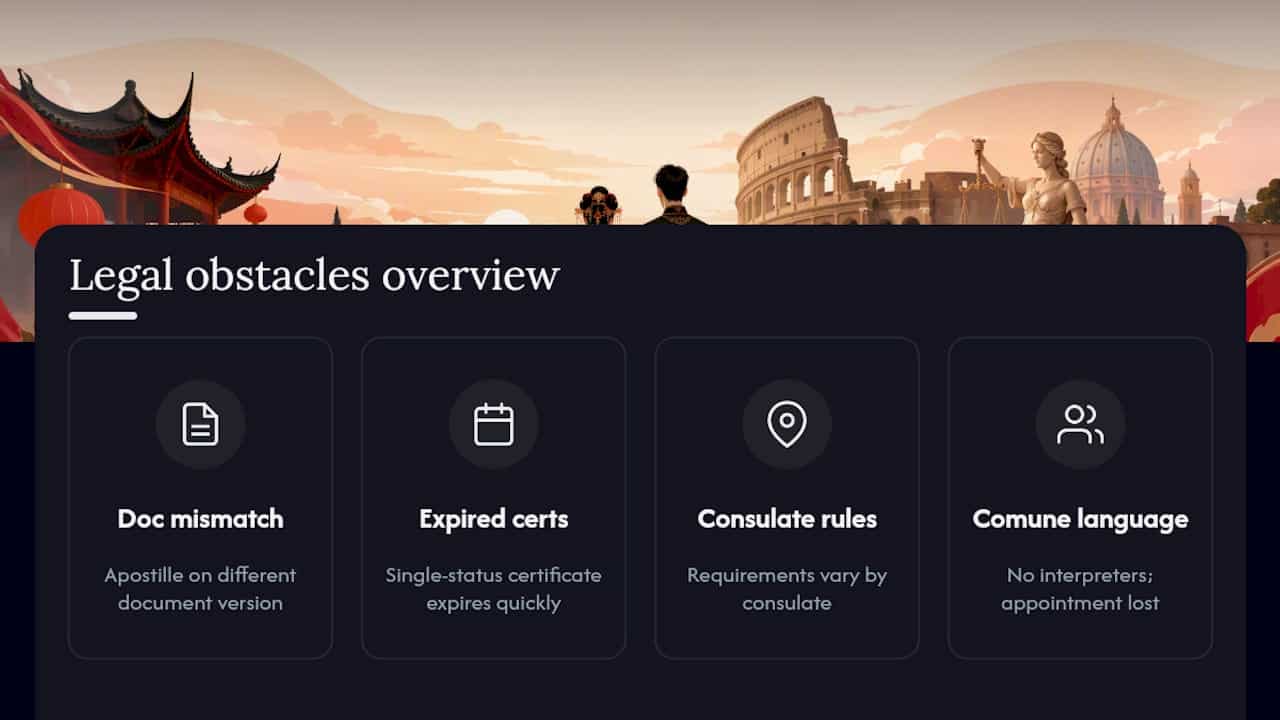
A second obstacle is expired certificates. The single-status declaration in particular has a short shelf life, and couples who spend months gathering other documents sometimes discover their free-status certificate has lapsed by the time they reach the Comune.
Consular inconsistency creates a third layer of difficulty. Because Chinese consular requirements evolve and can vary by jurisdiction, a document list confirmed with the Rome consulate may not match what Milan requests. The fix is straightforward, if tedious: confirm requirements directly and in writing with the exact consulate covering your case before assuming any online guide, including this one, applies without exception.
Language barriers at the Comune counter cause a fourth type of delay. Municipal staff outside major cities may have limited experience with Chinese documentation, and a couple showing up without an interpreter or a planner who has handled this before can lose an entire appointment slot to confusion over which stamp goes where.
The common thread across all four obstacles is the same: start early, verify everything twice, and treat the Comune and consulate as two separate bureaucracies that don’t automatically talk to each other.
What Visa or Residence Rules Apply to Chinese Citizens Marrying in Italy?
A Chinese citizen entering Italy solely to marry, without already holding a residence permit, generally enters on a Schengen short-stay visa (tourist or visitor category) if the wedding and return travel fit within the 90-day window. This visa does not, by itself, grant any right to remain in Italy afterward.
If the couple intends to live in Italy after marrying, the Chinese spouse should apply for a family reunification visa or, once married and the marriage is registered, a residence permit for family reasons. This is a different application from a tourist visa and typically must be initiated either before travel, through the Italian consulate in China, or shortly after the wedding through the local Questura.
Guests traveling from China for the ceremony itself remain on standard tourist visa rules, and processing times through Italian consular offices in China can run several weeks during busy travel seasons, which is one more reason invitations need to go out well ahead of the date.
Couples should not assume a valid marriage automatically extends anyone’s legal stay in Italy. The marriage and the residence permit are two separate administrative processes, and the permit application has its own paperwork, appointment, and processing timeline that runs independently of the wedding date itself.
Editorial Take: What Actually Matters for a Chinese Wedding in Italy
Most guides to this topic treat the legal process and the celebration as two separate projects. That’s backward, and it’s where couples lose months. The nulla osta timeline, the Comune’s publication window, and the venue’s banquet capacity all need to be mapped onto one calendar from day one, not planned in isolation and reconciled later.
The conventional advice, gather your documents, then book your venue, gets the order wrong for this specific situation. Venue availability in high season locks in nine to twelve months out, while consular and translation timelines can still shift due to jurisdictional inconsistencies well after you’ve signed a venue contract. The couples who do this well work both tracks simultaneously from the start.
What’s overrated is the assumption that a beautiful venue solves the hard part. It doesn’t. The hard part is the Apostille matching the translation matching the original, three documents that all have to agree, filed through two governments that don’t share records. That’s not a wedding planning problem in the traditional sense. It’s a compliance problem wearing a celebration’s clothes, and it deserves to be treated that way from the first phone call.
Let Sposiamovi Handle the Paperwork While You Plan the Celebration
Most couples navigating a Chinese wedding in Italy end up choosing between two frustrating paths: hiring a generalist wedding planner who has never faced a nulla osta, or managing consular liaison and venue contracts themselves alongside full-time jobs. Sposiamovi exists to remove that trade-off. The firm’s legal guidance work runs in parallel with venue sourcing and vendor management, so your document chain and your banquet menu get planned on the same calendar instead of two disconnected ones.
Concretely, that means Sposiamovi reviews your document checklist against your specific Comune’s requirements, coordinates sworn translations and asseveration with vetted legal translators, and shortlists venues, from a Tuscan estate like Villa Cora to a lakeside property on Lake Como, that can execute a multi-course banquet without improvising on the day. If your plans call for a more limited scope, Sposiamovi’s consulting service focuses specifically on legal and documentation support without a full planning engagement.
Reach out for a consultation, and the next steps are simple: a review of your document checklist, alignment of your legal timeline with your ideal wedding date, and a shortlist of venues suited to your cultural and guest-count needs.
This article is general information, not a substitute for advice from a qualified lawyer. Consult a qualified legal professional about your own circumstances before acting on anything here.
Sources
- Marriage in Italy | Italian Visa – LEXIA
- Matrimonio celebrato in Cina: come farlo riconoscere in Italia | SOS Online – ADUC
- Marriage for foreigners in Italy — Ministry of Justice (Italy)
FAQ
What documents are needed to marry a Chinese national in Italy?
You need a valid passport, notarized and legalized birth certificate, a certificate of free status, a nulla osta from the Chinese consulate legalized by the Prefettura, and a codice fiscale, all with sworn Italian translations where required.
Why are there no Chinese funeral customs practiced in Italy?
This question typically confuses search intent; Chinese funeral traditions can be observed privately in Italy, but they are rarely public because Chinese communities here are smaller and more dispersed than in mainland China, and formal facilities for specific rituals are limited.
Which marriages are not considered valid in Italy?
Marriages involving parties under legal age without judicial authorization, existing undissolved marriages (bigamy), certain close-relative unions, and marriages missing the required foreign spouse’s Certificate of No Impediment are not recognized as valid under Italian law.
Can a Chinese citizen hold dual Chinese and Italian citizenship?
China does not legally recognize dual citizenship, so a Chinese national who acquires Italian citizenship through marriage may be required to renounce Chinese nationality under Chinese law, even though Italy permits dual citizenship on its own side.
Recommended
- How to Plan a Multi-Cultural Wedding in Italy? – SposiamoVi
- How to Plan a Destination Wedding in Italy: Your Complete Timeline and Checklist – SposiamoVi
- What Are the Legal Requirements for Getting Married in Italy? – SposiamoVi
- How to Get Married in Italy as a Foreigner The Ultimate Guide – SposiamoVi