


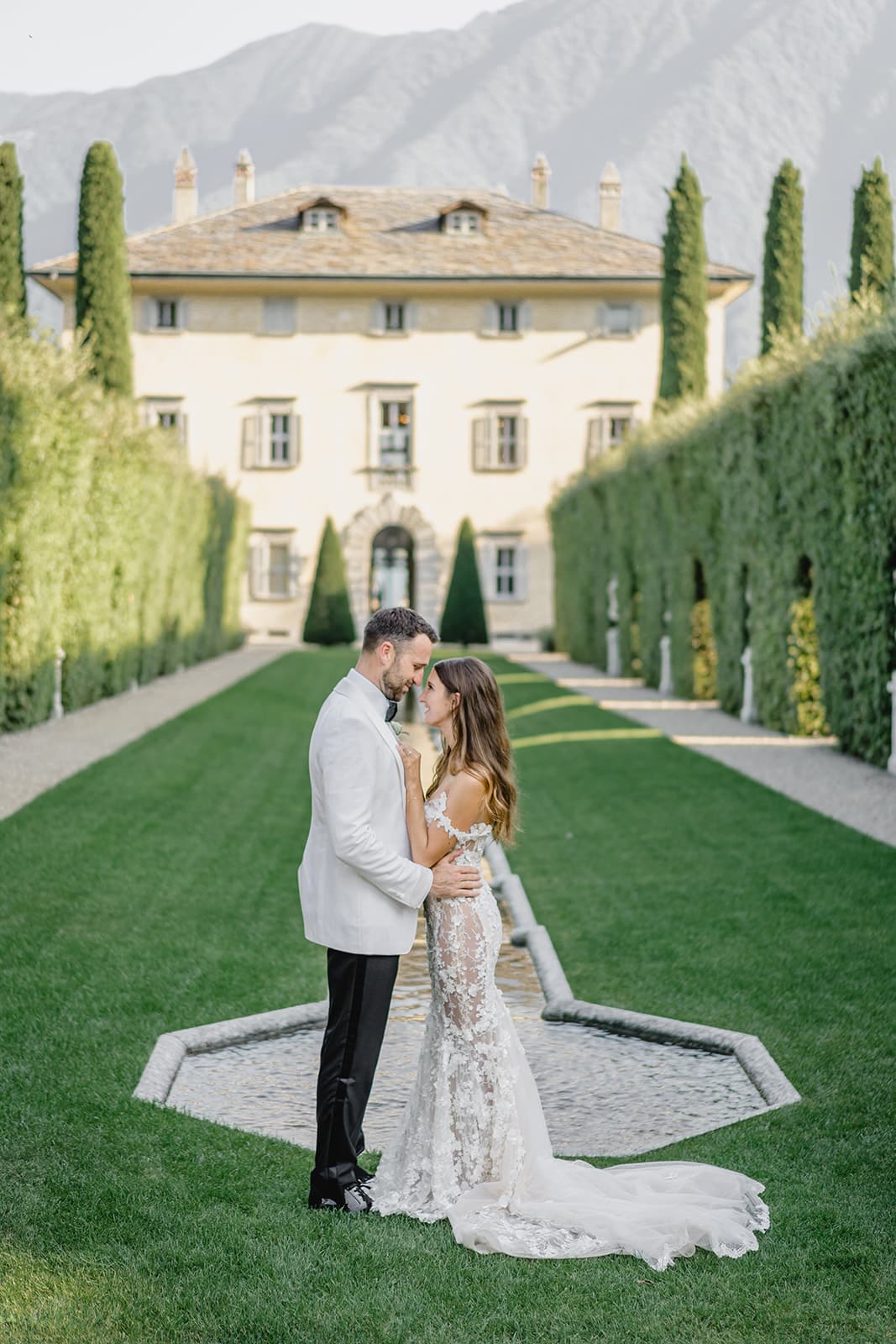
14 Sep Get 3 Capacity Numbers First: Why Italy Buyouts Need a Local Planner
An esclusiva location matrimonio, or exclusive wedding venue, is a property reserved entirely for your celebration, with no other guests, weddings, or hotel bookings on the grounds during your stay. It suits couples who want privacy, multi-day hospitality, and a level of service that only comes with full control of a property. The first practical step is to settle your guest count, pick a region, and decide whether you need onsite accommodation before you contact a single venue.
Table of Contents
- What Does Exclusive Use Actually Mean for a Venue?
- Which Italian Regions Offer the Best Exclusive Buyouts?
- What Should Be On Your Exclusive Venue Checklist?
- How Do Exclusive Venues Turn a Wedding Into a Weekend?
- What Does an Exclusive Wedding Venue Actually Cost?
- Why Hire a Local Luxury Planner for an Exclusive Venue?
- What the Research Actually Tells Serious Couples
- Let Sposiamovi Handle the Details You Shouldn’t Have To
- Sources
- FAQ
What Does Exclusive Use Actually Mean for a Venue?
The word “exclusive” gets applied loosely across Italian wedding marketing, and it pays to know the difference before you fall for a brochure photo. A true buyout means the entire property, grounds, guest rooms, and event spaces, belongs to your wedding alone. No other function, no hotel guests wandering past your ceremony, no shared parking lot with a corporate retreat wrapping up next door.
Partial exclusivity is different, and far more common than venues admit upfront. A property might reserve its main lawn and ballroom for you while still running its restaurant for outside diners, or renting a handful of rooms to unrelated travelers during your wedding weekend. That arrangement can still look elegant in photographs, but it changes the atmosphere entirely, and it changes your contract’s fine print.
Then there’s the shared-property scenario: some historic estates operate as working hospitality businesses year round, and “exclusive” only applies to specific hours or specific wings of the building. Ask directly which model you’re getting. A planner who has toured the property in person, rather than relying on a sales deck, will know the difference immediately.
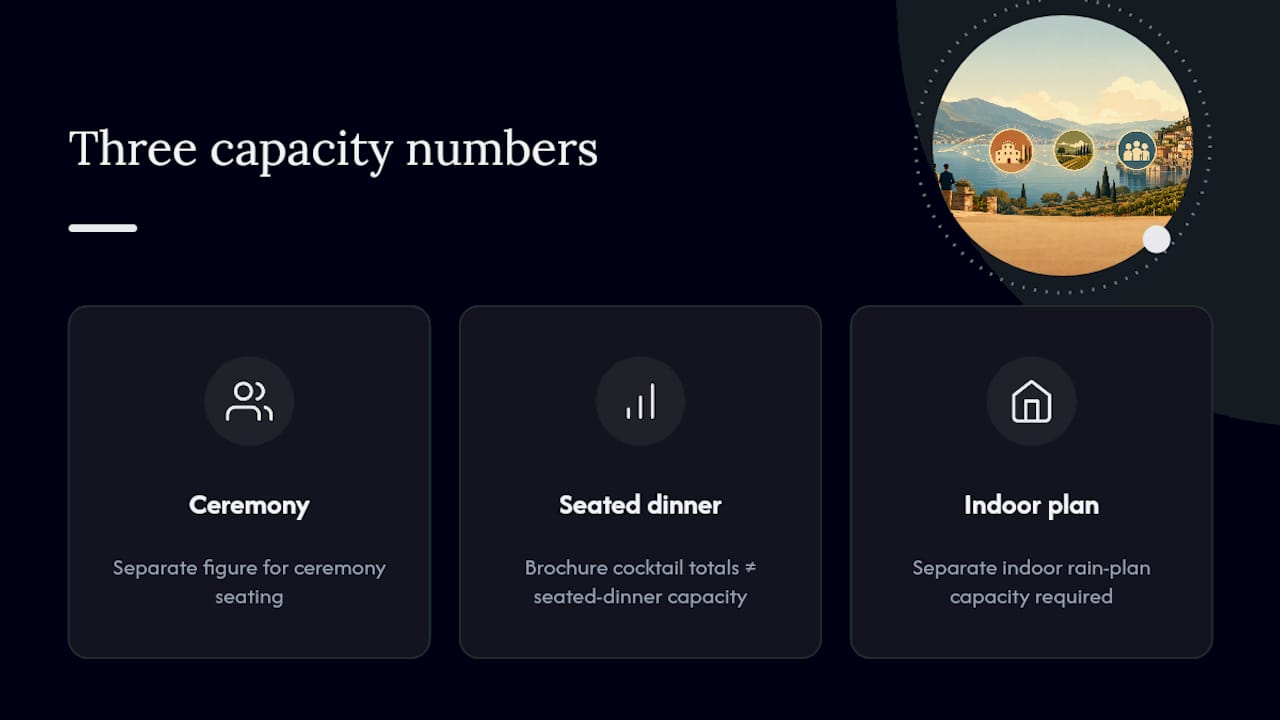
Capacity numbers matter more than square footage. Every serious venue conversation should produce three separate figures: how many guests fit for the ceremony, how many fit for a seated dinner, and how many fit in the indoor rain-plan space. Venue guides consistently flag mismatched capacity numbers as one of the most common planning pitfalls, and brochure totals often assume a cocktail-style layout that has nothing to do with a formal seated dinner.
What genuine exclusive hospitality includes, beyond the buyout itself:
- Dedicated staff assigned solely to your event, not shared with another function
- Private dining rooms available for welcome dinners or family gatherings separate from the main reception
- Full access to gardens, terraces, and grounds without shared pathways or sightlines
- Closed gates during your event window, meaning no outside day visitors or hotel guests
The contract is where good intentions get tested. Confirm the exact exclusivity window (does it start the morning of, or two days prior for setup), the deposit structure, the cancellation terms, and any noise or curfew restrictions tied to local ordinances. Many rural Italian properties operate under municipal noise limits after 11 PM or midnight, which can matter enormously if your reception is built around dancing until dawn. A luxury destination wedding planner reviews these clauses before you sign, not after.
Which Italian Regions Offer the Best Exclusive Buyouts?
Tuscany remains the benchmark for multi-day exclusive weddings, and for good reason. Private borgos and vineyard villas across the Chianti hills and the Val d’Orcia are built for exactly this format: a welcome dinner on Friday, ceremony and reception Saturday, farewell brunch Sunday, all on one property. Castel Monastero, for instance, offers full buyout across 68 rooms with a reception capacity approaching 200 guests, complete with onsite spa and restaurants that transform the wedding from a single event into a genuine hospitality project. Nearest airports are Florence and Pisa, both roughly ninety minutes from the Siena countryside by car.
Lake Como and Lake Maggiore deliver a different kind of drama. Waterfront villas with marble staircases descending to private docks create an arrival sequence no inland venue can match, and the photography speaks for itself. The trade-off is logistical: lake permits govern boat traffic and dock usage, and guest transfers often require a coordinated fleet of water taxis alongside road vehicles. Milan Malpensa is the primary gateway, generally an hour to ninety minutes from the lakeside towns depending on traffic.
The Amalfi Coast and Sorrento peninsula specialize in intimacy rather than scale. Cliffside monasteries and small coastal estates often cap at 60 guests, and that ceiling is deliberate, not a limitation. Smaller capacity preserves the sense that you’ve claimed something rare and remote. The coastal road here is narrow and winds constantly, so transfer times run longer than distance alone would suggest, and many couples base guests in Sorrento or Positano rather than attempt daily commutes.
Puglia has become the region insiders quietly recommend to couples who’ve already done Tuscany research and want something less expected. Masserie, the region’s fortified farmhouses, and countryside relais offer full-property buyouts with wide outdoor spaces made for long, unhurried dinners under olive trees. Puglia’s culinary identity, orecchiette, burrata, taralli, gives these weddings a distinct sense of place that’s harder to manufacture elsewhere. Bari and Brindisi airports serve the region, both under an hour from most estates.
Venice and the surrounding Veneto countryside offer historic palazzos and villas with ceremony options no other region can replicate: a private courtyard steps from the Grand Canal, or a Palladian villa on the mainland. Boat logistics for city-based weddings require early coordination, and municipal permits for canal-adjacent ceremonies take longer to secure than most couples expect.
Umbria, Tuscany’s quieter neighbor, has built a strong reputation for private castle weddings that feel genuinely secluded. Castello di Petrata, a 14th-century castle on a private fifty-hectare estate, hosts up to 100 guests across a multi-day format, with convenient access from Perugia, Rome, and Florence airports. Nearby, SPAO Borgo San Pietro offers exclusive use of a restored medieval borgo with 23 suites, positioned as a self-contained village for your entire wedding party rather than a single event space.
A quick reference on typical airport access by region:
| Region | Nearest major airport | Typical transfer time |
|---|---|---|
| Tuscany | Florence or Pisa | 60 to 90 minutes |
| Lake Como / Maggiore | Milan Malpensa | 60 to 90 minutes |
| Amalfi Coast | Naples | 75 to 120 minutes (coastal roads) |
| Puglia | Bari or Brindisi | 30 to 60 minutes |
| Venice / Veneto | Venice Marco Polo | 30 to 90 minutes |
| Umbria | Perugia, Rome, or Florence | 90 to 150 minutes |
What Should Be On Your Exclusive Venue Checklist?
A venue tour can feel seductive, all golden light and terracotta rooftops, which is exactly why you need a checklist that doesn’t bend to atmosphere. Work through these items in order, and don’t sign anything until each has a clear, written answer.
- Request the three capacity figures separately: ceremony seating, seated dinner, and indoor rain-plan capacity, along with layout diagrams for each scenario.
- Confirm the exact exclusive-use window, including whether it covers setup and breakdown days, and whether onsite accommodation is bundled into the buyout or billed separately.
- Walk the arrival sequence in person: the gate, the driveway, where cars park, and how guests move from arrival to ceremony without crossing service areas.
- Ask about ZTL restrictions if the venue sits near a historic center. Many Italian towns restrict vehicle access to a Zona a Traffico Limitato, which affects shuttle drop-off points and vendor deliveries.
- Get the vendor policy in writing: are outside caterers and florists permitted, is there a preferred supplier list, and what corkage fees apply if you bring your own wine.
- Clarify insurance requirements, permit responsibilities, and any noise curfews, particularly for outdoor receptions running past 11 PM.
- Confirm staffing levels included in the buyout price, and the overtime rate if your reception runs long.
- Map transport logistics for international guests, including which airport to recommend and realistic transfer windows given the region’s roads.
The arrival sequence deserves particular attention, because it’s where “exclusive” either feels real or falls flat. Evaluating a venue in person means checking how luggage and mobility-impaired guests will be handled, not just whether the driveway photographs well. A gate that opens onto a gravel lot with visible service vehicles undercuts the sense of transition that luxury weddings are built on.
Vendor policy is the checklist item couples most often skip, and it’s the one that produces the most expensive surprises. Many properties enforce preferred supplier lists or charge fees for rehearsal access and extra vendor hours, details that rarely appear in the initial brochure conversation.
Pro Tip: Never approve a rain-plan space from photos alone. Dark storage rooms and repurposed barns get dressed up in marketing shots, but if the indoor backup doesn’t match the outdoor plan’s aesthetic, your entire wedding is one weather forecast away from a disappointing pivot.
How Do Exclusive Venues Turn a Wedding Into a Weekend?
A single-day wedding asks guests to fly across an ocean for four hours of ceremony and dinner. A multi-day buyout asks them to arrive Thursday and leave Monday, and that shift changes everything about how the celebration feels. Intimacy deepens because your closest guests share meals, not just a reception. Scheduling loosens because you’re not racing a five-hour venue rental against sunset. And guests, especially ones who’ve traveled eight time zones, get an experience that justifies the trip.
A typical exclusive-buyout weekend runs something like this: a welcome dinner Friday evening, often more relaxed than the wedding itself, followed by a rehearsal Saturday morning, the ceremony and reception Saturday evening, and a farewell brunch Sunday before guests disperse. Full-buyout properties are specifically designed around this rhythm, with kitchens and staff scaled for three or four consecutive days of service rather than one.
The days between events are where exclusive venues earn their premium. Consider building in:
- A private wine tasting in the property’s cellar, or at a neighboring vineyard if the venue itself doesn’t produce
- A guided excursion to a nearby town, hill village, or coastal walk for guests who arrive early
- A hands-on cooking class, especially in Puglia or Tuscany, where regional cuisine is part of the draw
- A boat trip, if you’re near a lake or coastline, timed for golden hour rather than midday heat
Accommodation strategy needs its own plan. A full buyout with onsite rooms simplifies logistics enormously, but you’ll still need a rooming list that thinks carefully about who goes where. Reserve ground-floor or elevator-accessible rooms for older relatives, place your wedding party near each other for pre-ceremony coordination, and build in a contingency plan for guests who arrive later than expected. Properties with sixty or more rooms shift this from a courtesy into a genuine logistics project.
What Does an Exclusive Wedding Venue Actually Cost?
Four factors drive the price of an exclusive buyout more than any others: the season, your guest count, the length of the buyout, and the level of accommodation and catering you’re requesting. A three-night buyout in June commands a different price than a one-night October booking, and a 150-guest wedding scales differently than an 80-guest one across nearly every line item.
Deposit structures vary by property, but most exclusive-use venues in Italy require a substantial deposit at signing, generally nonrefundable, with the balance due closer to the event date. Cancellation terms tend to scale down in refundability the closer you get to the wedding, so read that clause with real attention rather than skimming past it.
Negotiation still has room to move, even at the luxury end. Off-peak dates, think late autumn or early spring rather than peak June through September, can soften pricing considerably. Some venues will negotiate a flat buyout fee against a minimum spend requirement, which can favor larger weddings over smaller ones depending on how the math works out. Room block commitments are another lever: properties sometimes reduce the buyout fee if you guarantee a minimum number of guest rooms booked.
Watch for hidden costs before you sign anything:
- Staffing overtime if your reception runs past the contracted hours
- Guest transfers, which add up quickly across a multi-day weekend with airport pickups and daily shuttles
- Security, particularly required at larger estates or high-profile bookings
- Permits for music curfews, fireworks, or drone photography
- Mandatory minimum room blocks that inflate your accommodation budget beyond what you’d planned
Why Hire a Local Luxury Planner for an Exclusive Venue?
Every item on the checklist above, capacity confirmation, contract review, vendor negotiation, transfer logistics, ZTL navigation, is easier with someone who has already walked these properties and negotiated these contracts. That’s the actual value a planner brings to an exclusive buyout: not inspiration, but execution.
A planner working across Italy handles the tasks that consume the most hours and carry the most risk: vetting sites in person rather than trusting a brochure, negotiating exclusivity clauses and cancellation terms, coordinating legal paperwork for couples marrying under a foreign legal system, and managing guest transport across airports, transfers, and accommodation blocks.
There are planners who specialize in this kind of work, with experience across Italian regions such as Lake Como, Tuscany, the Amalfi Coast, Puglia, Venice, and Portofino. The Sposiamovi portfolio documents real weddings across these regions, giving couples a concrete sense of what a fully executed exclusive buyout looks like beyond a venue’s own marketing.
Before your first consultation with any planner, prepare four things: your target dates or season, your realistic guest count, whether you want onsite accommodation for your full party, and your style priorities, whether that’s a Renaissance palazzo, a whitewashed masseria, or a lakeside villa. Walking in with those answers turns a vague inquiry into a productive first conversation.
- Site vetting and contract negotiation on properties you may never have toured in person
- Legal guidance specific to international couples marrying in Italy
- Guest transport coordination across airports, transfers, and multi-day accommodation
- Vendor sourcing that respects each venue’s preferred supplier list and corkage rules
What the Research Actually Tells Serious Couples
The biggest misconception about exclusive Italian weddings is that the venue is the hard part. It isn’t. Any couple with a good eye and enough time can find a beautiful buyout property through a weekend of research. The hard part is everything the brochure doesn’t mention: the mismatched capacity numbers, the vendor policy buried in an addendum, the ZTL restriction that blindsides your shuttle plan two weeks before the wedding.
Conventional wedding advice treats venue selection as the finish line. I’d argue it’s closer to the starting gate. The properties that photograph best, the private castles, the cliffside monasteries, are also the ones with the most operational complexity: smaller room counts, stricter transfer logistics, tighter noise curfews. Multi-day buyouts amplify that complexity rather than simplifying it, because now you’re managing accommodation, catering, and guest experience across three or four days instead of one afternoon.
What should come first isn’t the venue tour. It’s an honest accounting of your guest count, your accessibility needs, and your tolerance for logistics you can’t control from another country. Get that right, and the venue search gets dramatically easier.
Let Sposiamovi Handle the Details You Shouldn’t Have To
Sposiamovi exists for exactly the moment this article describes: you’ve found the region, maybe even the venue, and now you’re facing contracts, vendor policies, and transfer logistics that don’t translate cleanly across languages or legal systems. Rather than spending months chasing venue coordinators across time zones, Sposiamovi manages the entire process, from site vetting and contract negotiation to legal paperwork and guest accommodation, so the exclusivity you’re paying for actually feels effortless on the day.
This suits couples who’ve decided on a multi-day buyout in Tuscany, Lake Como, the Amalfi Coast, Puglia, Venice, or Portofino and want a single point of contact managing every moving piece. If you’re working against a tight timeline, the two-month planning guide shows how compressed timelines still work with the right coordination. Couples drawn to Tuscany specifically can review the guide to organizing luxury celebrations there for region-specific detail.
Reach out to Sposiamovi with your dates, guest count, and accommodation needs, and a planner will walk you through exclusive-use options that match your vision.
Sources
For couples researching specific properties, Castello di Petrata’s venue page details a private Umbrian castle built for multi-day buyouts. SPAO Borgo San Pietro showcases a full-borgo buyout format near the Tuscan border. Castel Monastero illustrates large-scale exclusive use with onsite hospitality. A broader roundup of Italian wedding venues offers additional comparison points across regions.
- Destination Wedding Venue in Italy | Luxury Castle in Umbria
- Luxury Wedding Venue in Umbria (Near Tuscany) | SPAO
- 20 best Italian wedding venues (journal article)
FAQ
What Is the Difference Between Exclusive Use and a Full Buyout?
Exclusive use can mean only the event spaces are reserved for you, while a full buyout reserves the entire property, including all guest rooms and grounds, exclusively for your wedding party.
How Many Guests Fit at a Typical Exclusive Venue in Italy?
Capacity varies widely by property. Umbrian castles like Castello di Petrata accommodate up to about 100 guests, while larger Tuscan estates like Castel Monastero can host up to around 200.
Do Exclusive Wedding Venues in Italy Require a Minimum Number of Nights?
Many multi-day buyout properties require a minimum stay, particularly during peak season from June through September.
What Should I Confirm Before Signing a Venue Contract?
Confirm the three capacity figures for ceremony, seated dinner, and indoor rain plan, the exact exclusivity window, deposit and cancellation terms, and the vendor policy for outside suppliers.
Is Hiring a Wedding Planner Worth It for an Exclusive Venue?
A planner who has toured and negotiated with Italian venues can catch contract issues, vendor restrictions, and logistics gaps that couples researching remotely typically miss; professional planners handle this vetting directly for international couples.