


03 Aug 10 Unique Wedding Venues in Italy
Why Choosing a Truly Unique Venue Changes Everything
A venue is not a container for a wedding. At its best, it becomes part of the celebration’s meaning — a place that holds the day in a way guests still talk about years later. SposiamoVi’s philosophy has always been that the right venue carries its own story, and when that story aligns with the couple’s own, something remarkable happens. The setting stops being a backdrop and starts being a participant.
Italy’s most memorable weddings share something in common: they happen in places with centuries of layered history, architectural character that could not have been invented, or natural drama that shifts how people feel from the moment they arrive. A clifftop monastery above the Amalfi Sea, a medieval hamlet in the Chianti hills, a palace where ancient Roman walls are still standing — these are not venues you replicate. They exist once, in one place, with one set of stories attached to them. That specificity is what transforms a luxury destination wedding in Italy into something genuinely irreplaceable.
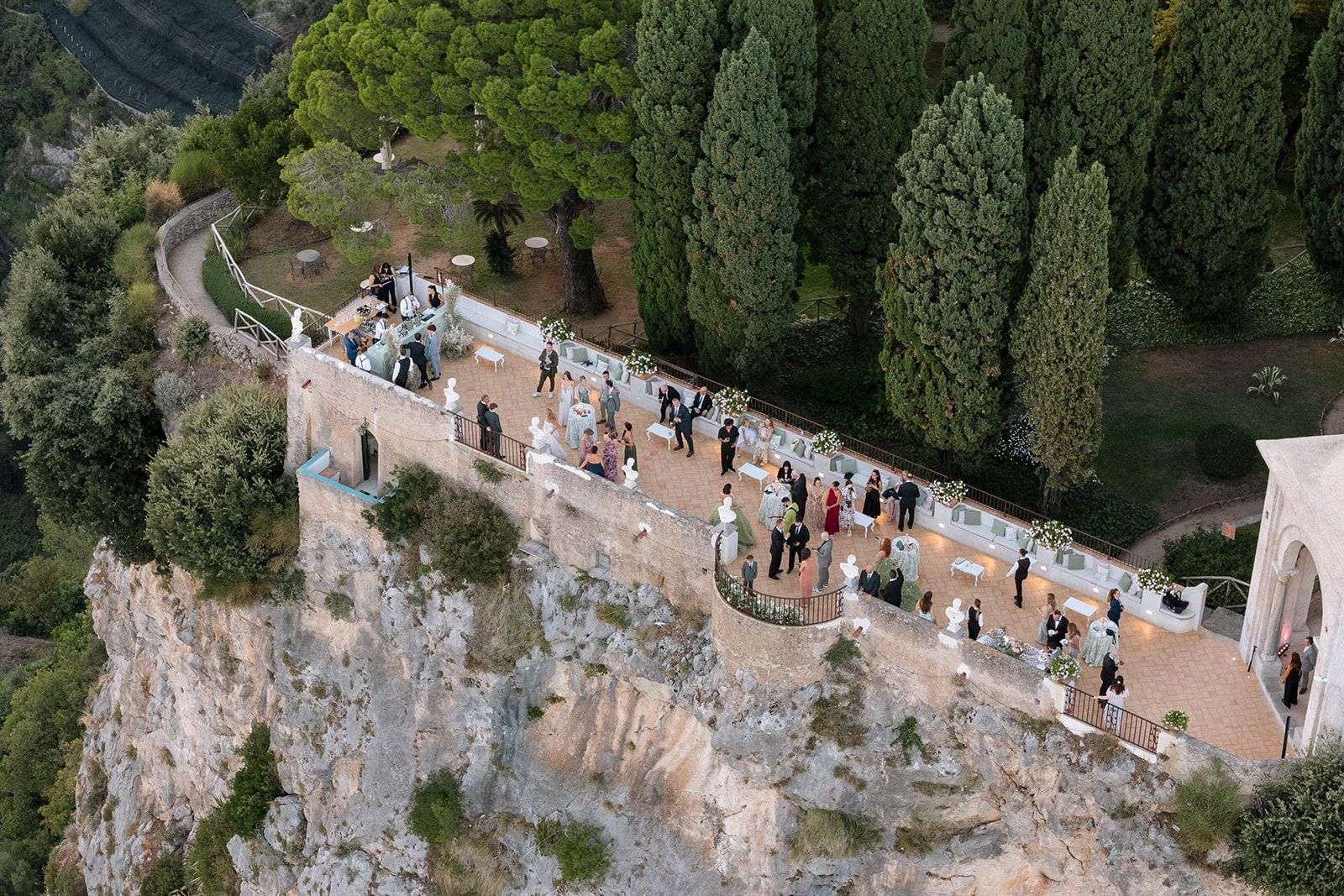
1. A 17th-Century Clifftop Monastery on the Amalfi Coast
Perched above the Tyrrhenian Sea between Positano and Amalfi, this former Dominican monastery dates to the 17th century and accommodates up to 60 guests on an exclusive-use basis. Its consecrated chapel, infinity pool carved directly into the cliff face, and terraced lemon gardens descending toward the water create an atmosphere that is both sacred and completely private.
An Amalfi Coast monastery wedding at this property offers something that larger, more accessible venues cannot: silence. The kind that comes from centuries of contemplative life lived in the same stone walls, in the same sea light. Guests arrive by boat and leave with the sense that they have been somewhere the rest of the world does not quite know about. For couples who want intimacy at scale — a small, close gathering in a setting of extraordinary physical drama — this is one of the most extraordinary exclusive Italian wedding venues on the entire coastline.
2. The Lake Como Villa You Can Only Reach by Boat
This 18th-century villa sits on a wooded promontory on Lake Como, accessible exclusively by vintage wooden launch. There is no road approach. Guests board the boat in the village and cross the lake’s famously still water, watching the villa emerge from the trees as they draw closer. That crossing is not a logistical detail — it is a ceremonial moment, the first act of a wedding weekend that has been designed from the beginning to feel unlike anything else.
The villa has served as a film location and carries the kind of visual authority that makes photographers and guests equally speechless. Its iconic loggia, formal gardens, and lakeside terraces accommodate up to 150 guests for a Lake Como wedding venue experience where the journey to the celebration is as unforgettable as the celebration itself. SposiamoVi coordinates the entire arrival sequence, ensuring the boat transfers are as considered and beautifully managed as every other element of the day.
3. An Entire Medieval Village in the Chianti Countryside
In the Chianti vineyards of Tuscany, roughly an hour south of Florence, stands an 11th-century hamlet where the entire borgo is yours for the weekend. Guests do not simply attend a wedding here — they inhabit one. Cobblestone lanes, a Romanesque chapel, and a refectory hall that has been standing for 900 years are all part of the fabric of daily life for the duration of your celebration.
This medieval village wedding in Tuscany accommodates up to 130 guests and is naturally suited to multi-day celebrations. A Friday welcome dinner in the refectory, a Saturday ceremony in the chapel, a Sunday brunch in the courtyard — the borgo makes a natural structure for an extended gathering without any of it feeling forced. The stone and the vines and the light do the work. SposiamoVi’s team manages the full guest journey, including accommodation within the hamlet’s historic buildings, so no one needs to leave the world you have created together.
4. A Roman Villa Built Above Ancient Ruins
Located outside Rome, this 16th-century villa was once the private retreat of one of the 20th century’s most celebrated collectors. When restoration work began on the foundations, builders uncovered extensive Roman ruins beneath the structure. Rather than conceal them, the decision was made to preserve them beneath glass floors — visible today from within the villa itself.
For couples who want Rome’s historical gravity without the noise and density of a city-center venue, this property offers something rare: Tyrrhenian Sea views, a provenance story that no other venue in central Italy can claim, and accommodation for up to 160 guests. SposiamoVi has a long-standing relationship with the estate’s custodians and can access it for dates and configurations that are not publicly listed.
5. An Island Wedding in a 16th-Century Watchtower
The volcanic island of Ischia, reached by ferry from Naples, offers an immediate and powerful separation from anything on the Italian mainland. The venue — a restored 16th-century watchtower positioned above a private bay — combines dramatic architecture, geothermal spa facilities, and the deep-blue water of the Campanian sea into a setting that feels genuinely removed from ordinary life.
The ferry crossing from Naples becomes part of the experience for guests, giving the weekend a built-in sense of arrival and adventure before anyone has even stepped ashore. This island wedding venue in Italy accommodates up to 120 guests and suits couples who want the intimacy of an island setting alongside the warmth of southern Italian culture. Ischia is significantly less visited than Capri while being, in many respects, more beautiful — which is part of its appeal to couples working with SposiamoVi who want a destination that feels genuinely discovered. Our guest concierge team coordinates every ferry crossing and private transfer.
6. A Frescoed Palace in the Shadow of the Colosseum
Built in the late 19th century on Rome’s Oppian Hill — where Emperor Nero’s imperial gardens once stood — this aristocratic palace incorporates ancient Roman walls into its structure and offers Colosseum views from its terraced gardens on clear evenings. The neo-Renaissance ballrooms are covered in original frescoes and scale to accommodate up to 800 guests across multiple event spaces.
For couples envisioning a grand Roman celebration with genuine historic depth, this is the only venue in Italy that combines this scale with this density of history in a single address. A historic Italian wedding venue of this kind demands planning experience equal to its ambition. SposiamoVi has coordinated celebrations here for international couples requiring full-service planning, multi-day programming, and the kind of seamless coordination that a property of this complexity requires.
7. A 10th-Century Baronial Castle in the Hills East of Rome
East of Rome in the Lazio hills stands a genuine 10th-century fortress — not a building that evokes a castle, but an actual medieval stronghold with towers, great halls, and ancient stone that has been part of the landscape for over a thousand years. Significantly restored in the 17th century, it accommodates up to 250 guests and remains one of the most visually commanding castle wedding venues in Italy.
What distinguishes this property for international couples is its accessibility. Some of Italy’s most authentic historic fortresses are genuinely remote, which makes guest logistics complicated. This castle sits within practical reach of Rome’s international airports while still delivering the full dramatic effect of a medieval stronghold. SposiamoVi regularly recommends it for couples who want the castle experience without asking guests to navigate the far reaches of the Italian countryside.
8. A Pugliese Estate Where a 2,100-Year-Old Olive Tree Witnesses Every Ceremony
In the Valle d’Itria in Puglia, this working 18th-century masseria sits within 35 hectares of ancient olive groves and accommodates up to 300 guests for a Puglia wedding masseria experience unlike any other in the region. At the center of the estate stands a single olive tree believed to have been planted around 100 BC — predating the Roman Empire, and still living.
Couples who say their vows beneath that tree are doing so in the presence of something that has endured the entirety of recorded Western history. It is one of the most quietly powerful ceremony settings in Italy, and it requires no decoration, no staging, and no special effect. The tree is enough. SposiamoVi works with this estate on a relationship basis, coordinating ceremonies, accommodation across the masseria’s historic buildings, and the regional excursions and culinary experiences that make a multi-day Pugliese wedding feel complete.
9. A Tuscan Villa in the Same Family Since 1527
Between Siena and Castelnuovo Berardenga in Tuscany stands a baroque villa classified as a National Heritage property that has been owned by the same noble family for nearly 500 years without interruption. Family portraits remain on the walls. An 18th-century private theatre still stands in the grounds. The family continues to live here, and when couples and their guests arrive, they are not entering a recreation of Italian aristocratic life — they are entering that life as it is still lived.
This historic Tuscan wedding venue accommodates up to 180 guests and suits couples who want a Tuscan celebration with genuine, unperformed authenticity. SposiamoVi’s relationship with the family spans many years and enables access to the estate for dates and configurations that go well beyond what any public listing describes. The villa is not a product. It is a home, and the experience of celebrating within it reflects that distinction at every point.
10. The Most Sought-After Wedding Address in Southern Puglia
Puglia’s most celebrated luxury resort was built from local limestone in a style that authentically recreates the traditional village aesthetic of the Valle d’Itria. With 183 accommodations, a private Adriatic beach club, Michelin-starred dining, and a world-class spa, it is the destination of choice for global figures who require both total privacy and world-class execution — and it has been for decades.
Celebrations here can accommodate up to 500 guests while maintaining the warmth and soul of authentic Pugliese culture. The resort’s scale means it can absorb a large international wedding without any element feeling compromised. SposiamoVi has coordinated multi-day celebrations at this property for couples who require full guest concierge services, private transfers, and access to the region’s most memorable culinary and cultural experiences alongside the formal wedding programme.
How SposiamoVi Helps You Secure the Right Venue
SposiamoVi has spent 20+ years building direct relationships with Italy’s most exclusive properties — not through directories or booking platforms, but through genuine long-term partnerships with estate owners, noble families, private trusts, and resort leadership. That means privileged access to dates, configurations, and in some cases properties that are never publicly listed.
For international couples, this access matters enormously. The venues described in this guide do not behave like hotels. Each one has its own terms, its own rhythms, and its own considerations around ceremony licensing, catering, accommodation, and exclusivity. SposiamoVi’s role is to guide couples through all of it honestly — from the first venue shortlist through to the final farewell on the last morning of the wedding weekend. You can explore the full range on our destination weddings page or browse real celebrations in our portfolio. The right venue is never simply the most famous or the most expensive. It is the one whose specific story resonates with the couple’s own. Finding that match, precisely and without wasted time, is what SposiamoVi does.
What to Ask Before You Book a Unique Italian Venue
Before confirming any exclusive-use property, SposiamoVi recommends that couples work through the following areas carefully.
First, exclusive-use terms: does your booking genuinely secure the entire property, or are parts of it accessible to other guests during your event? This question is more important than it appears, particularly at properties that operate as hotels during the broader season.
Second, on-site accommodation: can all or most of your guests sleep within the venue itself, and how does that affect the overall dynamic of a multi-day celebration? Third, ceremony licensing: international couples pursuing legally recognized ceremonies in Italy face specific requirements around civil or religious officiation, and not every venue is equally straightforward to license. SposiamoVi handles all civil and legal coordination as part of its consulting service.
Fourth, logistical accessibility: how do guests traveling from international airports reach the property, and what does that journey cost in time and complexity? Finally, catering: does the venue require use of an in-house catering team, or can SposiamoVi bring in the culinary partners best suited to the couple’s specific vision? The answer significantly affects both quality and budget.
Planning a Multi-Day Wedding Weekend in Italy
Many of Italy’s most distinctive venues are naturally designed for more than a single day. A medieval hamlet, a working masseria, an island watchtower — these are places where guests settle in, and where the experience deepens over time. A welcome dinner on the first evening, a ceremony and reception on the second, a day-after brunch or excursion on the third: this structure gives a wedding weekend its own narrative arc and turns a celebration into a genuine shared experience.
SposiamoVi coordinates the full guest journey for multi-day events: private transfers from international airports, regional excursions, guided tastings, boat trips, and the kind of daily concierge support that ensures no guest is ever uncertain about what comes next. Italy’s regions each offer their own set of complementary experiences — Chianti wine tours around a Tuscan borgo, thermal spa days on Ischia, trulli visits from a Pugliese masseria — and building those experiences into the weekend is something SposiamoVi does as a matter of course.
Ready to find the venue whose story matches your own? Reach out for a personalized consultation and we’ll begin the search together.
Frequently Asked Questions
What makes a wedding venue in Italy truly unique compared to a standard luxury option?
A truly unique venue has something that cannot be designed from scratch: a verifiable history, an architectural singularity, or a geographic position that changes how a place feels. Standard luxury venues offer high service levels and beautiful interiors. Unique venues — a 17th-century monastery, a 900-year-old borgo, an olive tree planted in 100 BC — carry meaning that was there long before any wedding took place. That is the distinction SposiamoVi focuses on when shortlisting properties for international couples.
How far in advance should international couples book an exclusive-use venue in Italy?
For Italy’s most sought-after exclusive-use properties, 18 to 24 months in advance is standard for peak season dates (May through October). Some of the venues listed here hold only one or two weddings per season, which means availability is genuinely limited. SposiamoVi recommends beginning the venue search as early as possible and can advise on which properties have immediate availability for specific date windows.
Can SposiamoVi arrange weddings at private historic estates not widely listed online?
Yes. A significant part of SposiamoVi’s portfolio consists of private estates, noble family properties, and historic venues that operate exclusively through direct relationships rather than public listing. These properties are often the most distinctive in their respective regions precisely because they are not widely marketed. Couples working with SposiamoVi gain access to venues they would not find through standard searches.
Which Italian regions offer the most distinctive venue options for destination weddings?
Tuscany, Puglia, the Amalfi Coast, Lazio, and the lakes region (Lake Como in particular) offer the widest range of architecturally and historically distinctive properties. Each region has its own character: Tuscany for historic estates and medieval villages, Puglia for masserie and ancient olive groves, the Amalfi Coast for clifftop drama and intimate scale, Lazio for Roman provenance, and Lake Como for aristocratic grandeur and lakeside setting.
Is it possible to have a legally recognized ceremony at historic venues like monasteries or medieval castles in Italy?
Yes, though the process depends on the specific venue, its licensing status, and the couple’s nationality. Civil ceremonies can be conducted at many private historic venues by a local civil registrar. Religious ceremonies require the venue to hold the appropriate ecclesiastical designation. SposiamoVi manages all legal and administrative coordination for international couples, including working with local authorities to ensure full legal recognition in the couple’s home country.
How does SposiamoVi support guests traveling internationally to remote or island venues?
SposiamoVi’s guest concierge service covers the full arrival and departure journey. For island venues such as Ischia, that includes coordinating ferry crossings and private boat transfers from Naples. For remote Tuscan or Puglian estates, it means arranging private coach transfers from the nearest airports and managing all ground logistics. Guests receive a personalised itinerary with everything they need to arrive confidently, regardless of where in Italy the venue is located.
What is the typical guest capacity range for exclusive-use venues in Italy?
Italy’s exclusive-use historic venues range considerably in scale. Intimate clifftop properties on the Amalfi Coast may accommodate as few as 40 to 60 guests, while grand Roman palaces and Pugliese resorts can host between 500 and 800 guests. Most of the venues in SposiamoVi’s portfolio fall between 100 and 300 guests — a scale that balances intimacy with the logistical and experiential richness of a full destination wedding weekend.